
Jentan Fisheries Practical Training Series
Recognising Distress in Newly Hatched Catfish Fry
An Educational Guide for Fish Farmers
Learn how normal yolk-sac behaviour differs from warning and emergency signs, what water-quality checks to make immediately, and how to respond systematically when fry behaviour changes.
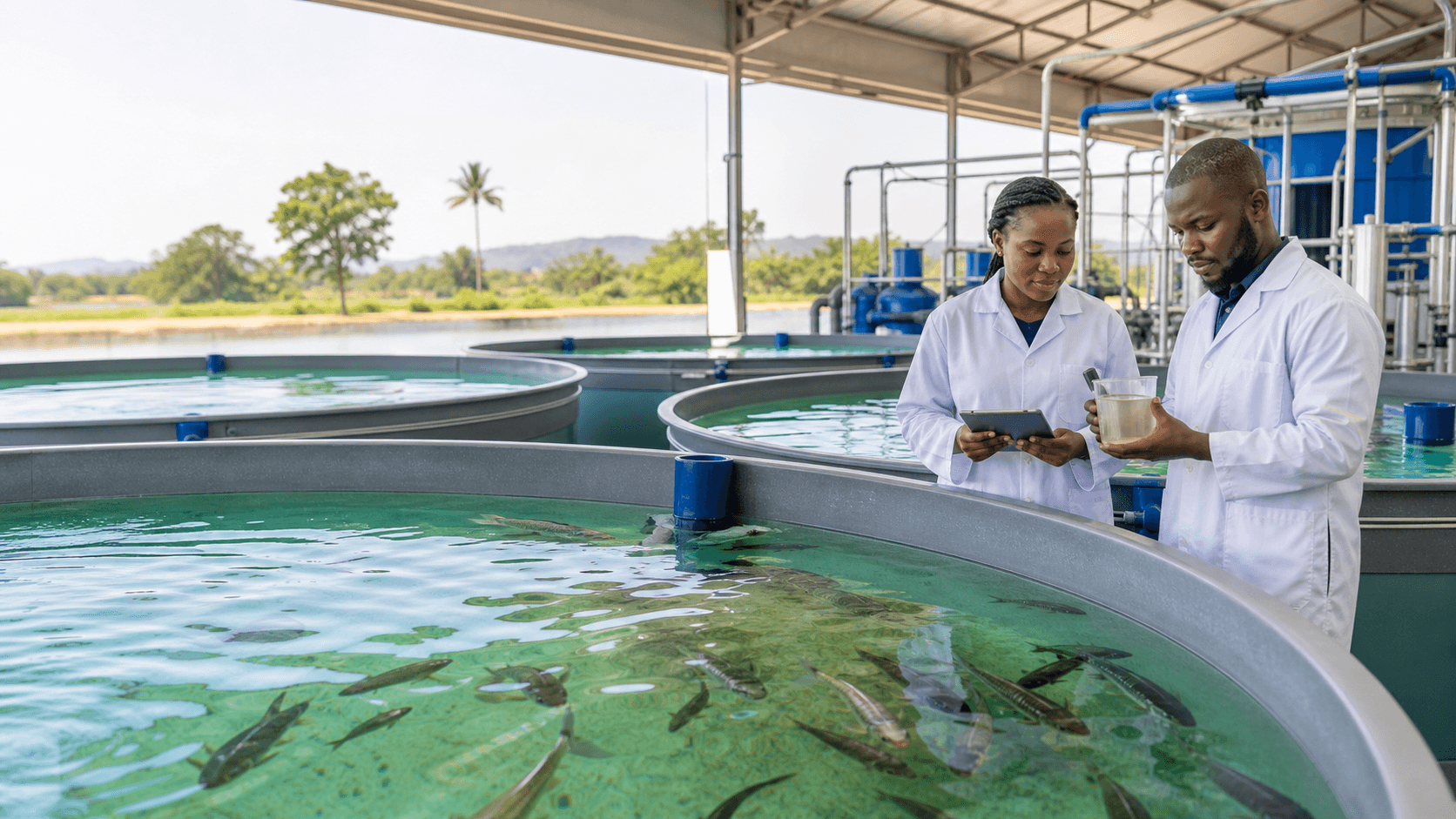
Newly hatched African catfish (Clarias gariepinus) fry are extremely vulnerable to changes in their environment. A water-quality problem can affect thousands of larvae before obvious mortality begins. For this reason, farmers should learn to recognise behavioural changes as an early-warning system. Swimming pattern, position in the tank, responsiveness and congregation around water inlets or aeration points can provide valuable clues that fry are under stress.
Normal Behaviour During the Yolk-Sac Stage
Inactivity does not always mean distress. Immediately after hatching, catfish larvae may spend considerable periods resting on the bottom or against tank surfaces while absorbing their yolk sacs.
Short bursts of swimming followed by resting can be normal. Fry may also cluster in darker areas.
Healthy larvae should, however, retain normal orientation and show some response when the surrounding water is gently disturbed.
The Green-Amber-Red Early-Warning System
| Status | What You May See | What To Do |
|---|---|---|
| GREEN - NORMAL | Resting during the yolk-sac stage; short bursts of swimming; reasonable distribution; normal orientation; response to gentle disturbance. | Continue routine observation. Maintain stable water quality and aeration. |
| AMBER - WARNING | More fry than usual at the surface; congregation around the inlet or aeration; persistent darting or twitching; unusual crowding in one area; increasing lethargy. | Immediately measure dissolved oxygen, temperature, pH, ammonia/TAN and nitrite. Check water flow and aeration. |
| RED - EMERGENCY | Repeated rising and sinking; spiralling, rolling or sideways swimming; inability to maintain equilibrium; widespread weakness; fry lying on their sides; sudden population-wide mortality. | Treat as an emergency. Increase safe aeration/oxygenation, investigate water quality and source water immediately, and check all tanks. |
Key Distress Behaviours and What They Can Mean
Surface congregation
When large numbers of fry suddenly remain near the surface, consider inadequate dissolved oxygen, excessive carbon dioxide, poor gas exchange or impaired respiration.
Clustering around the inlet or aeration point
This may indicate that fry are seeking water with higher oxygen or better water quality than elsewhere in the tank.
Erratic swimming, darting or twitching
Persistent abnormal movement can accompany acute environmental stress or irritation. A population-wide change is more significant than occasional movement by individual fry.
Loss of equilibrium
Spiralling, rolling, swimming sideways or upside down is a serious warning sign. Fry that cannot maintain normal orientation require immediate investigation.
Lethargy and poor responsiveness
Severely stressed fry may become quiet rather than frantic. Widespread weakness, especially when combined with abnormal posture, can precede mortality.
Crowding in one part of the tank
Fry may be avoiding an unfavourable current, temperature zone or area of poorer water quality.
Repeated rising and sinking
If many larvae repeatedly move vertically through the water column, investigate respiratory and environmental stress immediately.
Five Water-Quality Checks to Make Immediately
- Dissolved oxygen (DO) - Aim to maintain well-oxygenated water. A practical hatchery target is around 5-7 mg/L, while avoiding operation close to a minimum threshold.
- Temperature - African catfish eggs and larvae generally perform well in warm, stable water. Approximately 27-30°C is commonly used for incubation and early larval rearing. Avoid abrupt temperature changes.
- pH - A practical range around 6.5-8.0 is generally suitable, but stability is crucial. Sudden pH shifts can stress larvae and also change ammonia toxicity.
- Ammonia - Measure total ammonia nitrogen (TAN) and consider the unionised ammonia (NH3) fraction. NH3 becomes more toxic as pH and temperature increase. Keep it as close to zero as practicable.
- Nitrite - Keep nitrite as low as practicable. Any upward trend in a newly established or unstable recirculating system should trigger investigation, particularly when fry behaviour changes.
Do Not Wait for Dead Fry
JENTAN FARMER'S RULE: If a large proportion of fry suddenly change where they are located or how they are swimming, treat the change as a water-quality alarm until measurements show otherwise.
Distinguishing an Incubation Problem from a Post-Hatch Problem
Poor fry survival does not always originate after hatching. Farmers should observe the entire egg-to-larva transition.
Warning signs during incubation include delayed or uneven hatching, large numbers of unhatched eggs while other larvae are already free-swimming, abnormal larvae immediately after emergence, and heavy mortality shortly after hatch.
These observations may point toward fertilisation, egg handling, incubation conditions, temperature, fungal or bacterial problems, or water-quality stress rather than a problem arising only during larval rearing.
A Simple Hatchery Response Procedure
- Observe the entire tank before intervening: note where fry are concentrating and whether the behaviour is population-wide.
- Measure dissolved oxygen and temperature immediately.
- Check pH, TAN/ammonia and nitrite.
- Confirm that aeration, oxygen supply, pumps, water inlet and recirculation are operating correctly.
- Compare affected tanks with apparently normal tanks and, where possible, compare inlet water with tank water.
- Correct the identified problem gradually and safely. Avoid abrupt changes in temperature, pH or other water conditions.
- Record the time, behavioural signs, water-quality readings, action taken and subsequent response of the fry.
Final Message to Fish Farmers
Successful hatchery management depends on observation as much as equipment. Instruments tell the farmer what is happening in the water; the fry often provide the first indication that something has changed.
Learn the normal behaviour of your larvae, establish routine water-quality monitoring, and investigate sudden population-wide behavioural changes immediately. Early intervention can make the difference between a manageable water-quality event and the loss of an entire hatch.
Educational Note
This guide is intended for farmer education and routine hatchery management. Exact safe limits and corrective actions can vary with water chemistry, stocking density, system design and larval age.
Where unexplained mortality persists despite acceptable water-quality readings, seek assistance from an aquaculture specialist or aquatic animal-health professional.
Put the guide into practice
Jentan Fisheries can support farmers with practical hatchery training, water-quality troubleshooting and diagnostic guidance when fry survival or behaviour becomes abnormal.