
Jentan Fisheries Practical Training Series
Catfish Feeding and Feed Management: How to Reduce Feed Cost and Improve Growth
Learn practical catfish feeding and feed management in Nigeria. Understand feed selection, pellet size, biomass calculations, feeding frequency, FCR, feed storage and how to reduce feed waste while improving fish growth.
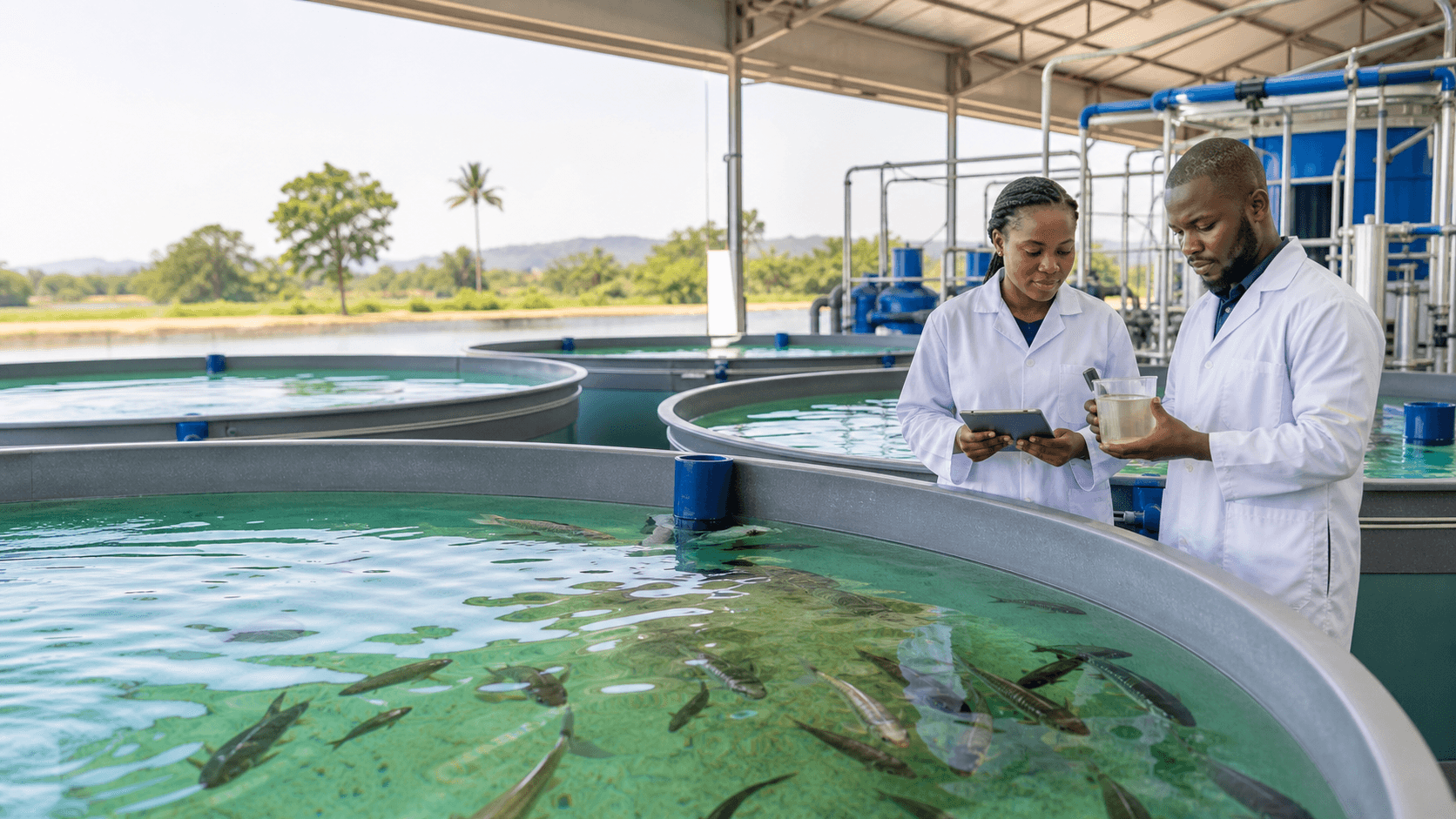
What You Will Learn
By the end of this guide, a fish farmer should be able to:
- Select appropriate feed for different stages of catfish production;
- Match pellet size to the size of the fish;
- Estimate the biomass of fish in a pond or tank;
- Calculate a daily feed ration;
- Adjust feeding according to fish behaviour and performance;
- Measure Feed Conversion Ratio, or FCR;
- Calculate feed cost per kilogram of fish produced;
- Recognise signs of overfeeding and underfeeding;
- Reduce unnecessary feed losses;
- Store fish feed correctly;
- Use farm records to improve feeding decisions; and
- Identify when poor growth is being caused by something other than feed.
1. Why Feeding Management Determines Catfish Farm Profitability
Feeding is not simply the act of throwing pellets into a pond.
It is one of the most important management functions on a commercial catfish farm.
Feed is also one of the largest operating expenses facing Nigerian aquaculture producers. Recent WorldFish fieldwork in Nigeria describes fish feed as one of the biggest costs facing producers, while Nigerian farm-level research identifies feed price and Feed Conversion Ratio among the variables with the strongest relationship to profitability.
This means that two farmers can stock the same number of fish, use the same brand of feed and sell at the same market price, yet achieve very different profits.
The difference may come down to how they manage feed.
A farmer who wastes 50 kilograms of feed has not only lost the cost of those 50 kilograms. Uneaten feed can also deteriorate water quality, increase organic waste and, in intensive systems, place additional pressure on mechanical and biological filtration.
FAO guidance on aquaculture feeding makes the principle clear: underfeeding reduces production, while overfeeding wastes expensive feed and can contribute to water-quality deterioration.
The objective, therefore, is not:
Feed the fish as much as possible.
The objective is:
Convert the right quantity and quality of feed into the greatest economically useful fish growth while maintaining good water quality and fish health.
That is feed management.
2. The Seven Principles of Good Catfish Feeding
Every catfish farmer should understand seven basic principles.
Principle 1: Feed according to fish size
Small fish have different nutritional and pellet-size requirements from larger fish.
Principle 2: Feed according to biomass
The amount of feed required depends on the total weight of fish in the production unit, not simply on the number originally stocked.
Principle 3: Measure growth regularly
You cannot manage feed properly if you do not know the approximate current weight of your fish.
Principle 4: Observe the fish while feeding
Fish behaviour provides valuable information about appetite, health, oxygen availability and environmental stress.
Principle 5: Measure feed efficiency
The farmer should know how much fish weight is being produced from every kilogram of feed.
Principle 6: Protect feed quality
Good feed that becomes wet, mouldy, contaminated or rancid during storage can become a poor feed.
Principle 7: Feed for profit, not merely for rapid consumption
The cheapest feed is not necessarily the most economical feed, and the most expensive feed is not automatically the best.
The correct question is:
How much does it cost me in feed to produce one kilogram of saleable fish?
3. Understanding Catfish Feed
Commercial fish feed is formulated to provide nutrients required for growth, maintenance, health and normal biological functions.
The principal nutritional components include:
- Protein;
- Lipids or fats;
- Carbohydrates;
- Vitamins;
- Minerals;
- Essential amino acids; and
- Energy.
African catfish (Clarias gariepinus) have particularly high nutritional requirements during their early life stages. FAO's review of feed management practices for African catfish reports high protein requirements in larvae and early juveniles, after which nutritional requirements can be adjusted as fish become larger.
This is one reason farmers should not use the same feed specification throughout the entire production cycle.
4. Do Not Judge Fish Feed by Protein Percentage Alone
Farmers often compare feed by asking:
"How many percent protein does it contain?"
Protein is important, but protein percentage alone does not tell you whether a feed will perform well.
A good commercial feed should also have:
- Appropriate amino-acid balance;
- Suitable energy content;
- Good-quality ingredients;
- Good digestibility;
- Appropriate fat content;
- Adequate vitamins and minerals;
- Good pellet integrity;
- Low levels of fines and powder;
- Consistency from one batch to another;
- Good water stability;
- Appropriate pellet size; and
- Proper storage before it reaches the farmer.
A feed containing a high percentage of poorly digestible protein may be less economical than a properly formulated feed with a somewhat different declared protein level.
Judge feed by fish performance and production economics, not by the label alone.
5. Selecting Feed for Different Sizes of Catfish
Feed size should generally increase as the fish grow.
Nigeria's National Agricultural Extension and Research Liaison Services identifies very small feeds or mash for fry, approximately 0.8–1 mm pellets for small fish, 2–3 mm pellets for juveniles and larger pellets for adults.
A practical farm guide can be organised as follows:
| Fish Stage | Approximate Pellet Approach |
|---|---|
| Fry/very small post-fry | Crumble or very fine starter feed |
| Small fingerlings | Approximately 0.8–1.5 mm |
| Larger fingerlings | Approximately 1.5–2 mm |
| Juveniles | Approximately 2–3 mm |
| Growing fish | Approximately 3–4.5 mm |
| Larger grow-out fish | Approximately 4.5–6 mm |
| Large table-size fish | Approximately 6 mm or larger where appropriate |
This table is a practical guide, not a rigid standard. Pellet sizes vary among manufacturers. Always consider the actual mouth size, average fish weight, feed manufacturer's recommendations and observed feeding performance.
How do you know a pellet is too large?
Possible signs include:
- Fish repeatedly taking and rejecting pellets;
- Smaller fish being unable to consume them;
- Pellets remaining uneaten;
- Uneven access to feed;
- Reduced feeding intensity.
How do you know the pellet is unnecessarily small?
Very small pellets fed to large fish can:
- Increase feeding time;
- Increase losses;
- Produce more fines;
- Make it harder to monitor consumption; and
- Potentially increase handling and feed costs.
6. Floating Feed or Sinking Feed?
Both can be used successfully when properly formulated and managed.
Floating Feed
Floating feed provides a major management advantage because the farmer can observe:
- How aggressively the fish are feeding;
- Whether the feed is being consumed;
- Whether appetite has suddenly declined;
- Whether some sections of the pond contain inactive fish; and
- Whether the ration needs adjustment.
For beginners and intensive production systems, this visibility can be particularly valuable.
Sinking Feed
Properly formulated sinking feed can also support good growth and may sometimes be more economical.
However, it is harder to determine:
- How much has actually been eaten;
- Whether feed is accumulating on the bottom;
- Whether feed wastage is occurring.
The correct decision should therefore consider feed quality, cost, production system and observed FCR, rather than assuming that one feed form is automatically superior.
7. The Most Important Feeding Calculation: Fish Biomass
Feed should be related to the current biomass in the tank or pond.
Biomass means the estimated combined weight of all the fish.
Formula
Fish Biomass = Number of Fish Alive × Average Fish Weight
Example
A tank contains an estimated:
1,000 fish
The average sampled weight is:
100 grams per fish
Convert grams to kilograms:
100 g = 0.1 kg
Therefore:
1,000 × 0.1 kg = 100 kg biomass
The tank contains approximately:
100 kg of fish biomass
This figure becomes the basis for determining the daily ration.
8. How to Calculate Daily Feed Requirement
Daily feed can be calculated as a percentage of estimated fish biomass.
Formula
Daily Feed = Biomass × Feeding Rate
Suppose:
- Estimated biomass = 100 kg;
- The farm's feeding plan calls for 4% of biomass per day.
Then:
100 kg × 4% = 4 kg
The planned daily ration would therefore be:
4 kg of feed per day
If the fish are being fed twice daily:
4 kg ÷ 2 = 2 kg per feeding
If three times daily:
4 kg ÷ 3 = approximately 1.33 kg per feeding
The 4% used here is only an illustrative calculation, not a universal recommendation.
The correct percentage depends on:
- Fish size;
- Age;
- Water temperature;
- Feed quality;
- Production system;
- Stocking density;
- Fish health;
- Water quality;
- Natural food availability in ponds; and
- Manufacturer recommendations.
FAO specifically cautions against using one fixed biomass percentage throughout the entire production cycle because feeding requirements change substantially as fish grow.
9. Why Feeding Percentage Should Decline as Fish Grow
Small fish consume more feed relative to their body weight than large fish.
This means a farmer should not feed a 20-gram fish and a 700-gram fish using the same percentage of biomass without considering their different metabolic and growth requirements.
A common mistake is:
"I was told to feed 5% body weight, so I feed 5% from stocking until harvest."
This can create major problems.
As fish grow:
- Total biomass increases;
- Individual metabolic requirements relative to body weight change;
- Pellet size changes;
- Feeding frequency may change;
- The quantity of feed per meal changes;
- Water-quality load increases;
- The system's carrying capacity becomes increasingly important.
Your feeding programme should therefore be progressive, not fixed.
10. How Often Should Catfish Be Fed?
Feeding frequency should also change with fish size and production stage.
Very young fish generally need smaller and more frequent meals.
Research on Clarias gariepinus fry and fingerlings found growth benefits from multiple daily feedings, with fry benefiting from very frequent meals and fingerlings in that particular trial performing well when their daily ration was divided across several meals.
Farmers should not turn the results of one experiment into an inflexible rule, however. Feeding frequency should be adapted to:
- Fish size;
- Production system;
- Feed characteristics;
- Labour availability;
- Water conditions;
- Fish appetite; and
- Farm performance records.
A practical approach is:
| Production Stage | Feeding Approach |
|---|---|
| Fry | Small meals several times daily |
| Fingerlings | Several controlled meals daily |
| Juveniles | Usually divided daily feeding |
| Grow-out fish | One or more carefully controlled meals depending on the system |
| Large finishing fish | Feeding frequency and ration adjusted to appetite, growth target and farm economics |
The most important point is that total daily feed and fish response matter more than simply counting the number of meals.
11. What Time of Day Should Catfish Be Fed?
There is no single clock time that is optimal for every production system.
Feeding should be scheduled when:
- Dissolved oxygen is adequate;
- Water conditions are stable;
- Staff can observe the feeding response;
- Fish are not under acute stress; and
- Feed can be distributed consistently.
In outdoor ponds, farmers should be particularly careful early in the morning because dissolved oxygen can be relatively low after overnight respiration.
In RAS and intensive tanks with reliable aeration and oxygen management, environmental conditions may be more controllable.
Consistency helps establish a predictable feeding response, but the farmer should never continue a routine simply because "it is feeding time" if the fish are showing signs of oxygen stress or abnormal behaviour.
12. Never Feed Fish Without Looking at Them
Feeding time is also inspection time.
A trained farmer should observe:
Before feeding
- Are the fish behaving normally?
- Are they swimming normally?
- Are they congregating around aeration points?
- Are any fish gasping?
- Are mortalities present?
- Is water flow normal?
- Are pumps and aerators working?
During feeding
- Do the fish respond rapidly?
- Is feeding distributed across the population?
- Are only the largest fish reaching the feed?
- Are pellets accumulating?
- Does appetite suddenly decline?
After feeding
- Is uneaten feed visible?
- Are fish remaining active?
- Is water quality deteriorating?
- Does the next meal need adjustment?
A farmer who simply measures feed, throws it into the water and walks away is missing valuable information.
13. Feed to Biomass — But Verify With Appetite
Biomass calculations provide a planned ration.
Fish behaviour provides a reality check.
Suppose your calculated daily ration is 10 kg.
If the fish suddenly stop feeding vigorously after 7 kg, do not automatically force the remaining 3 kg into the pond merely because the spreadsheet says 10 kg.
Investigate.
Reduced appetite may indicate:
- Low dissolved oxygen;
- High ammonia;
- Elevated nitrite;
- Disease;
- Temperature stress;
- Recent grading or handling;
- Sudden water-quality change;
- Poor-quality feed;
- Feed rancidity;
- Excessive previous feeding; or
- A biomass estimate that is no longer accurate.
Feed calculations and observation must work together.
14. Feed Distribution Matters
Do not repeatedly throw all the feed into one small area unless the production system specifically requires it.
Poor distribution can allow dominant fish to consume disproportionate amounts while weaker fish receive less.
In tanks and ponds where appropriate:
- Spread feed across a suitable feeding zone;
- Observe where fish congregate;
- Avoid dumping the entire ration at once;
- Allow time for fish to consume pellets;
- Pay attention to smaller fish;
- Grade fish when size differences become excessive.
Uneven feeding often produces uneven growth.
15. Why Grading Improves Feed Efficiency
Catfish do not always grow uniformly.
After several weeks, one tank may contain:
- Very large fish;
- Medium-sized fish;
- Small fish.
This creates several problems.
Larger fish may:
- Reach feed first;
- Consume a disproportionate share;
- Injure or prey on smaller fish;
- Require a different pellet size.
Smaller fish may become increasingly disadvantaged.
Regular grading helps produce groups of more similar size and allows feeding to be better matched to actual fish requirements.
Better size uniformity can improve:
- Feed access;
- Growth monitoring;
- Pellet-size selection;
- Harvest planning; and
- Biomass estimation.
16. Sample the Fish Regularly
You cannot calculate biomass accurately forever using the stocking weight.
If you stocked:
1,000 fish at 20 g, your starting biomass is:
20 g × 1,000 = 20,000 g
= 20 kg
But after several weeks those fish may average 100 g, 200 g or considerably more.
Using the original weight to calculate feed would produce a serious feeding error.
Practical sampling procedure
At regular intervals:
- Select fish from different parts of the production unit.
- Avoid deliberately selecting only the largest fish.
- Count the sampled fish.
- Weigh them together.
- Calculate average weight.
- Review estimated survival.
- Recalculate biomass.
- Adjust the feed ration.
Formula
Average Fish Weight = Total Sample Weight ÷ Number of Fish Sampled
Example:
30 sampled fish weigh a combined:
6 kg
Average weight:
6 kg ÷ 30
= 0.2 kg
= 200 g per fish
If estimated population is 900 fish:
900 × 0.2 kg
= 180 kg biomass
Your feeding plan should now be based on approximately 180 kg, not on the original stocking biomass.
17. Do Not Forget Mortality When Calculating Biomass
Suppose you stocked:
1,000 fish
but 100 have died.
You cannot continue calculating feed for 1,000 fish.
Estimated population is now:
900 fish
If mortality is not recorded, the farm will increasingly overestimate biomass and may overfeed.
Every mortality should therefore be:
- Counted;
- Recorded;
- Removed promptly;
- Investigated if abnormal; and
- Reflected in stock estimates.
Unrecorded mortality also corrupts FCR calculations.
18. Feed Conversion Ratio: The Number Every Catfish Farmer Should Know
Feed Conversion Ratio, normally abbreviated FCR, measures how efficiently feed is converted into fish weight.
Formula
FCR = Feed Consumed ÷ Fish Biomass Gained
Suppose a production unit consumes:
1,500 kg of feed
During the same period, fish biomass increases by:
1,000 kg
Then:
1,500 ÷ 1,000
= 1.5
The FCR is:
1.5
This means approximately 1.5 kg of feed was used for every 1 kg of biomass gain.
19. Why Lower FCR Usually Matters
Consider two farms.
Farm A
Feed consumed:
1,300 kg
Fish biomass gained:
1,000 kg
FCR:
1.3
Farm B
Feed consumed:
1,800 kg
Fish biomass gained:
1,000 kg
FCR:
1.8
Farm B used:
500 kg more feed
to produce approximately the same biomass gain.
If feed costs ₦1,500 per kilogram, for example:
500 kg × ₦1,500
= ₦750,000
The difference in feeding performance could therefore represent ₦750,000 in additional feed expenditure in this hypothetical example.
This illustrates why FCR should be monitored continuously rather than calculated only after harvest.
Recent analysis of Nigerian catfish farms found that FCR and feed price are among the variables most strongly associated with profitability.
20. Do Not Chase an Unrealistic FCR
FCR must be interpreted carefully.
It varies according to:
- Fish size;
- Feed quality;
- Water quality;
- Stocking density;
- Survival;
- Production system;
- Feed wastage;
- Disease;
- Genetics;
- Sampling accuracy;
- Natural productivity of ponds; and
- Quality of farm records.
A farmer who reports an extremely low FCR may simply have inaccurate:
- Feed records;
- Stock counts;
- Fish weights; or
- Mortality records.
The objective is not to advertise the smallest number.
The objective is to obtain a reliable FCR that supports profitable production.
21. Calculate Feed Cost Per Kilogram of Fish Produced
FCR becomes even more useful when combined with feed price.
Formula
Feed Cost per kg of Fish Gain = FCR × Feed Price per kg
Example:
Feed price:
₦1,500/kg
FCR:
1.4
Therefore:
1.4 × ₦1,500
= ₦2,100
Feed alone has cost approximately:
₦2,100 per kilogram of biomass gain
before accounting for:
- Fingerlings;
- Labour;
- Electricity;
- Diesel;
- Water;
- Treatments;
- Maintenance;
- Transport;
- Finance costs;
- Mortalities;
- Marketing; and
- Other overheads.
This calculation is far more useful than simply asking:
"Which bag of feed is cheapest?"
22. Cheap Feed Can Be Expensive
Imagine two feeds.
Feed A
₦1,500/kg
FCR = 1.3
Feed cost per kg of gain:
₦1,500 × 1.3
= ₦1,950
Feed B
₦1,200/kg
FCR = 2.0
Feed cost per kg of gain:
₦1,200 × 2.0
= ₦2,400
Although Feed B costs less per kilogram, it costs ₦450 more in feed to produce one kilogram of fish in this illustration.
Therefore:
Buy feed on performance, not bag price alone.
23. How to Test Whether a New Feed Is Actually Cheaper
Do not change the entire farm to a new feed simply because a salesperson claims it is cheaper.
Conduct a controlled farm trial.
Use similar groups of fish with:
- Comparable starting weights;
- Similar stocking densities;
- Similar water conditions;
- Similar management.
Record:
- Starting biomass;
- Feed supplied;
- Mortality;
- Final biomass;
- FCR;
- Feed price;
- Feed cost per kilogram gained;
- Survival;
- Growth rate;
- Water-quality effects.
Then compare the economics.
This converts feed purchasing from opinion into farm data.
24. Commercial Feed Versus Farm-Made Feed
Farm-made feed can reduce cost, but only if it is properly formulated and produced.
A study involving juvenile African catfish found that properly formulated on-farm feed could achieve growth and survival comparable to the industrial feed used in the trial while reducing feed cost substantially. The result depended on correct formulation and processing; one of the farm-made formulations performed less well than the better formulation.
The lesson is not:
Homemade feed is always cheaper.
The correct lesson is:
Properly formulated farm-made feed may reduce production cost, but poor formulation can sacrifice growth and profitability.
Before producing commercial quantities of feed, the farmer should understand:
- Ingredient nutrient composition;
- Protein requirements;
- Amino-acid balance;
- Energy;
- Lipid requirements;
- Fibre limitations;
- Ingredient digestibility;
- Anti-nutritional factors;
- Vitamin and mineral supplementation;
- Grinding;
- Mixing;
- Extrusion or pelleting;
- Drying;
- Water stability;
- Storage; and
- Quality control.
Feed formulation should be treated as a technical discipline, not as mixing ingredients by guesswork.
25. Ten Practical Ways to Reduce Catfish Feed Cost
1. Start With Good Fish
Poor-quality fish seed can produce:
- Poor growth;
- Uneven size;
- Higher mortality;
- Worse feed utilisation.
Saving money on poor juveniles can therefore increase later feed cost.
2. Know Your Biomass
Do not feed by guesswork.
Sample regularly.
3. Record Every Bag of Feed
Feed leaving the store should be traceable to a pond, tank or production batch.
4. Reduce Feed Spillage
A kilogram spilled onto the floor should be treated as a financial loss.
5. Match Pellet Size to Fish Size
Oversized pellets can be rejected.
Undersized pellets can create unnecessary waste and inefficient feeding.
6. Maintain Good Water Quality
Poor water quality suppresses appetite and growth.
Feed cannot compensate for poor oxygen or toxic ammonia.
7. Grade Fish
Uniform fish compete more evenly and can be fed more appropriately.
8. Compare Feeds Using FCR
Do not compare brands only by price.
9. Store Feed Correctly
Prevent moisture, mould, rodents and contamination.
10. Stop Feeding Problems
When appetite changes suddenly, investigate before continuing the normal ration.
26. Feed Storage: Protect the Money You Have Already Spent
Once feed enters your farm, it becomes inventory with a monetary value.
It should be stored:
- In a dry location;
- Away from direct sunlight;
- In a ventilated store;
- Off the floor;
- Away from walls where moisture may accumulate;
- Protected against rodents and insects;
- Away from chemicals, fuel and pesticides.
Use pallets or suitable raised platforms.
Follow:
First In, First Out — FIFO
Older feed should normally be used before newer stock, subject to condition and expiry dates.
Check bags for:
- Moisture;
- Mould;
- Unusual smell;
- Clumping;
- Insects;
- Torn packaging;
- Excessive fines.
Do not assume that an unopened bag is automatically good.
27. Never Feed Mouldy or Spoiled Feed
Feed showing mould growth, severe moisture damage, rancidity or unusual contamination should not be given to fish.
Spoiled feed may:
- Have reduced nutritional value;
- Reduce appetite;
- Affect fish health;
- Contaminate production water.
The value of a bag of feed is insignificant compared with the value of the fish population it could compromise.
28. Feeding and Water Quality Are One Management System
Every kilogram of feed entering a fish production system eventually contributes to:
- Fish growth;
- Fish metabolism;
- Faecal waste;
- Dissolved waste;
- Uneaten feed; or
- Microbial activity.
In RAS, feeding load directly affects:
- Solids production;
- Ammonia production;
- Oxygen demand;
- Biofilter loading;
- Carbon dioxide production;
- Alkalinity consumption.
A farmer cannot sensibly increase feed input indefinitely without considering the treatment capacity of the system.
The correct question is not only:
"Can the fish eat more?"
Also ask:
Can the system safely process the waste created by feeding more?
29. When Should Feeding Be Reduced or Temporarily Withheld?
A farmer should consider reducing or temporarily withholding feed when fish are under severe stress or when conditions make normal feeding unsafe.
Examples include:
- Severe oxygen depletion;
- Major pump or aeration failure;
- Dangerous ammonia or nitrite conditions;
- Acute disease investigation;
- Immediately after severe handling stress;
- Major water-quality disruption;
- Transport preparation where fasting is part of the protocol.
The appropriate response depends on the severity of the situation.
Do not continue heavy feeding merely because it appears on the daily schedule.
30. Fish Not Eating? Do Not Automatically Change the Feed
Poor appetite can be caused by many things.
Use this diagnostic sequence.
Step 1 — Check Oxygen
Are fish gasping or congregating at the surface or aeration points?
Step 2 — Check Water Quality
Measure, as appropriate:
- Temperature;
- pH;
- Ammonia;
- Nitrite;
- Dissolved oxygen;
- Water flow.
Step 3 — Check Equipment
Are:
- Pumps running?
- Aerators working?
- Filters operating?
- Outlets blocked?
Step 4 — Check Fish
Look for:
- Wounds;
- Abnormal swimming;
- Discolouration;
- Swollen abdomen;
- Excess mucus;
- External parasites;
- Unusual mortality.
Step 5 — Check Feed
Ask:
- Is this a new batch?
- Has the brand changed?
- Is the pellet size appropriate?
- Is the feed stale?
- Was it exposed to moisture?
- Does it smell unusual?
Step 6 — Review Previous Feeding
You may simply have overfed previously.
Diagnose before treating.
31. The Jentan Feed Management Record
Each production unit should have a daily feeding record.
A simple format is:
| Date | Tank/Pond | Estimated No. Fish | Avg. Weight | Biomass | Feed Type | Pellet Size | Feed Given | Mortality | Feeding Response | Remarks |
|---|
At each sampling, add:
- Sample size;
- Average weight;
- Estimated survival;
- New biomass;
- Cumulative feed;
- Biomass gain;
- FCR.
32. Example of a Practical Feeding Review
Assume a farmer stocked:
1,000 juveniles
After several weeks:
- Estimated surviving population = 950;
- Average fish weight = 250 g;
- Cumulative feed used = 300 kg.
Step 1 — Calculate current biomass
250 g = 0.25 kg
950 × 0.25
= 237.5 kg
Step 2 — Compare with initial biomass
Suppose initial biomass was:
10 kg
Biomass gain:
237.5 − 10
= 227.5 kg
Step 3 — Calculate FCR
300 kg feed ÷ 227.5 kg gain
= 1.32
Approximate FCR:
1.32
The farmer now has a measurable basis for evaluating performance.
33. Weekly Catfish Feeding Management Routine
Once each week, the farmer or farm manager should review:
Fish
- Estimated population;
- Mortality;
- Average weight;
- Size variation;
- Behaviour;
- Health.
Feed
- Quantity consumed;
- Feed remaining in stock;
- Pellet size;
- Feed condition;
- Feed price.
Performance
- Biomass;
- Weight gain;
- FCR;
- Growth trend.
Water
- Dissolved oxygen;
- pH;
- Temperature;
- Ammonia;
- Nitrite;
- Other relevant parameters.
Equipment
- Pump performance;
- Aeration;
- Biofilter;
- Water flow;
- Backup power.
Business
- Feed cost;
- Cost per kg gain;
- Expected harvest date;
- Expected sale size;
- Current market price.
This weekly review turns feeding from a routine activity into a management system.
34. A Simple Feed-Control System for Commercial Farms
Commercial farms should separate responsibility for:
Feed Purchase
Who approves feed purchases?
Feed Receipt
Who counts and verifies bags delivered?
Feed Storage
Who controls the store?
Feed Issue
How much feed was released to each production unit?
Feeding
Who actually administered it?
Recording
Who records feed consumed?
Reconciliation
Does:
Opening Stock + Purchases − Feed Issued = Closing Stock?
Without this control system, a farm may have good fish performance but still lose money through poor inventory management, theft or inaccurate records.
35. Common Feeding Mistakes
Mistake 1: Feeding by number of fish rather than biomass
Fish weight changes continuously.
Mistake 2: Using one feeding rate throughout production
Fish requirements change as they grow.
Mistake 3: Feeding without sampling
This produces increasingly inaccurate ration estimates.
Mistake 4: Ignoring mortality
You may be feeding fish that no longer exist.
Mistake 5: Using the wrong pellet size
This reduces feeding efficiency.
Mistake 6: Selecting feed only by price
Cheap feed can produce expensive fish.
Mistake 7: Throwing feed and walking away
Feeding response is valuable diagnostic information.
Mistake 8: Feeding during oxygen stress
This can worsen an already dangerous situation.
Mistake 9: Keeping feed directly on the floor
Moisture can damage feed.
Mistake 10: Not calculating FCR
Without FCR, a farmer cannot properly evaluate feed efficiency.
36. The Jentan Five-Minute Feeding Check
Before every major feeding, ask five questions:
1. Are the fish behaving normally?
YES / NO
2. Is aeration and water circulation working?
YES / NO
3. Is the feed appropriate for the current fish size?
YES / NO
4. Do I know approximately how much feed this unit should receive?
YES / NO
5. Am I going to watch the fish while they eat?
YES / NO
If the answer to the first two questions is NO, investigate before feeding.
37. The Jentan Rule for Reducing Feed Cost
Do not begin by asking:
"How can I buy cheaper feed?"
Begin by asking:
How can I produce each kilogram of healthy, marketable fish with less feed waste and better feed conversion?
The answer may involve:
- Better fingerlings;
- Better feed;
- Better water quality;
- Better grading;
- Better feeding technique;
- Better sampling;
- Better recordkeeping;
- Better biosecurity;
- Better inventory control.
Feed management is therefore not just about feed.
It is about the entire production system.
38. Ten Rules Every Catfish Farmer Should Remember
- Never feed without observing the fish.
- Know the approximate biomass in every production unit.
- Sample fish regularly.
- Adjust pellet size as fish grow.
- Record every kilogram of feed used.
- Monitor mortality and survival.
- Calculate FCR.
- Protect water quality.
- Compare feed by cost per kilogram of fish produced, not bag price alone.
- Investigate abnormal appetite before adding more feed or chemicals.
39. Final Practical Exercise
A farmer has:
- 2,000 catfish;
- Estimated survival of 95%;
- Average weight of 300 g.
Question 1 — How many fish remain?
2,000 × 95%
= 1,900 fish
Question 2 — What is the estimated biomass?
300 g = 0.3 kg
1,900 × 0.3 kg
= 570 kg biomass
Suppose the farm's current feeding plan is 3% of biomass per day.
Question 3 — What is the planned daily ration?
570 × 3%
= 17.1 kg/day
If divided into two meals:
17.1 ÷ 2
= approximately 8.55 kg per meal
The farmer should then observe the feeding response rather than blindly forcing the entire calculated ration into the water.
40. Key Performance Indicators for Feed Management
A professionally managed catfish farm should be able to produce these figures for each production batch:
| Indicator | Farmer Should Know |
|---|---|
| Number stocked | Yes |
| Starting average weight | Yes |
| Starting biomass | Yes |
| Current estimated population | Yes |
| Current average weight | Yes |
| Current biomass | Yes |
| Cumulative feed used | Yes |
| Feed cost | Yes |
| Mortality | Yes |
| Survival rate | Yes |
| FCR | Yes |
| Feed cost/kg biomass gain | Yes |
| Expected harvest weight | Yes |
| Expected harvest date | Yes |
If several of these figures are unknown, feed management is largely being conducted by guesswork.
41. Practical Takeaway
The secret to reducing catfish feed cost is not necessarily feeding less.
Feeding too little may extend the production cycle and reduce output.
The objective is to feed more efficiently.
A profitable feeding programme combines:
Good fish seed
*
Correct feed
*
Correct pellet size
*
Accurate biomass
*
Controlled ration
*
Good feeding technique
*
Good water quality
*
Regular sampling
*
Accurate FCR
*
Strong records
=
Better growth and better control of feed cost
Learn Practical Catfish Feeding at Jentan Fisheries
Reading provides the foundation. Practical farm experience develops competence.
The Jentan Fisheries Catfish Feeding and Feed Management Training Programme is designed to help farmers understand how feeding decisions affect growth, survival, water quality and profitability.
Practical training can include:
- Fish biomass estimation;
- Sampling and weighing;
- Feed-ration calculations;
- Feed-size selection;
- Feeding demonstrations;
- FCR calculations;
- Feed-cost analysis;
- Water-quality interpretation;
- Farm recordkeeping; and
- Troubleshooting poor growth.
Suitable for:
- New fish farmers;
- Existing catfish farmers;
- Hatchery operators;
- Farm managers;
- Farm attendants;
- Investors planning fish farms; and
- Entrepreneurs interested in commercial aquaculture.
Need Help With Poor Growth or High Feed Costs?
If your fish are:
- Growing slowly;
- Consuming excessive feed;
- Showing uneven sizes;
- Producing poor FCR;
- Refusing feed;
- Experiencing unexplained mortality; or
- Costing more to produce than expected,
the problem may involve more than the feed itself.
Use the Jentan Fisheries Diagnostic & Advisory Service
Submit information on:
- Fish size;
- Stocking population;
- Tank or pond size;
- Feed type;
- Daily feed quantity;
- Water quality;
- Mortality;
- Growth history; and
- Production system.
A structured assessment can help identify the most likely causes and appropriate corrective actions.
About Jentan Fisheries
Jentan Fish Hatchery and Farms Limited 1 Jentan Close, off Nnewi–Ozubulu Road Uruokwe, Ozubulu Ekwusigo Local Government Area Anambra State, Nigeria
Website: jentanfisheries.com
Jentan Fisheries supports fish farmers through quality fish seed, practical aquaculture training, farm diagnostics, production guidance and modern fish-farming practices.
References and Further Learning
This training publication draws on aquaculture feeding principles and research from the Food and Agriculture Organization of the United Nations, WorldFish, Nigeria's National Agricultural Extension and Research Liaison Services and peer-reviewed studies on African catfish feeding and farm economics. FAO's On-farm Feeding and Feed Management in Aquaculture provides a broad technical reference on feeding management, while recent WorldFish work confirms the continuing importance of feed cost in Nigerian aquaculture.
Research on Nigerian catfish production also demonstrates the importance of FCR and feed price to farm profitability.
Put the guide into practice
Learn with Jentan, investigate poor growth or unusual feeding behaviour, or reserve healthy fish seed for your production plan.