
Jentan Aquaculture Academy
Introduction to Fish Farming: A Practical Guide for Beginners in Nigeria
Fish farming can become a productive agribusiness when it begins with sound planning, healthy stock, suitable water and disciplined management. This guide explains the practical foundations Nigerian beginners should understand before stocking their first fish.
What Is Fish Farming?
Fish farming, also called aquaculture, is the planned breeding, stocking, feeding and management of fish in a controlled environment. Unlike capture fishing, which depends on harvesting wild fish, aquaculture allows a farmer to manage the production cycle—from selecting stock to feeding, monitoring growth and harvesting.
A commercial fish farm is more than a pond filled with fish. It is a biological production system and a business. The farmer manages water, oxygen, feed, fish density, health, labour, records, sales and risk at the same time. Success therefore depends on preparation and consistent daily management.
Why Fish Farming Matters in Nigeria
Fish is an important source of animal protein for Nigerian households, restaurants, hotels and institutions. Aquaculture helps meet this demand while creating opportunities in hatchery production, grow-out farming, feed distribution, processing, transport, equipment supply, training and farm support.
Commercial opportunity
A well-managed farm can sell live fish, fresh fish, smoked fish or graded stock to several customer groups.
Scalable production
Farmers can begin with a manageable unit and expand after proving their water, market and management systems.
Shorter cycles
Depending on species, stock quality, feeding and conditions, fish production can provide a practical route to recurring sales.
Food security
Local aquaculture strengthens access to quality fish and supports value chains within Nigerian communities.
Choosing a Fish Species
African catfish
African catfish is widely farmed in Nigeria because it is familiar to consumers, tolerates a range of production systems and has established markets for live, fresh and smoked fish. It still requires good water quality, appropriate stocking density and careful feeding.
Tilapia
Tilapia is valued for its taste, hardiness and market potential. Farmers must plan population control and stock management carefully because uncontrolled reproduction can cause overcrowding and uneven growth.
Choose a species only after confirming your market, climate, water source, production system and technical capacity. Jentan supplies graded fingerlings and juveniles and can help customers understand suitable stock for their plans.
Fish Production Systems
Earthen ponds
Earthen ponds can support natural productivity and larger production areas, but they require suitable soil, dependable water, drainage, security and careful pond preparation.
Concrete or block ponds
Concrete ponds make observation, cleaning and harvest easier. Their water must be managed deliberately because they have less natural buffering than earthen ponds.
Tarpaulin and plastic tanks
These systems are quick to install and useful where permanent construction is unsuitable. Farmers should confirm tank strength, drainage, temperature exposure and realistic stocking capacity.
Recirculating Aquaculture Systems (RAS)
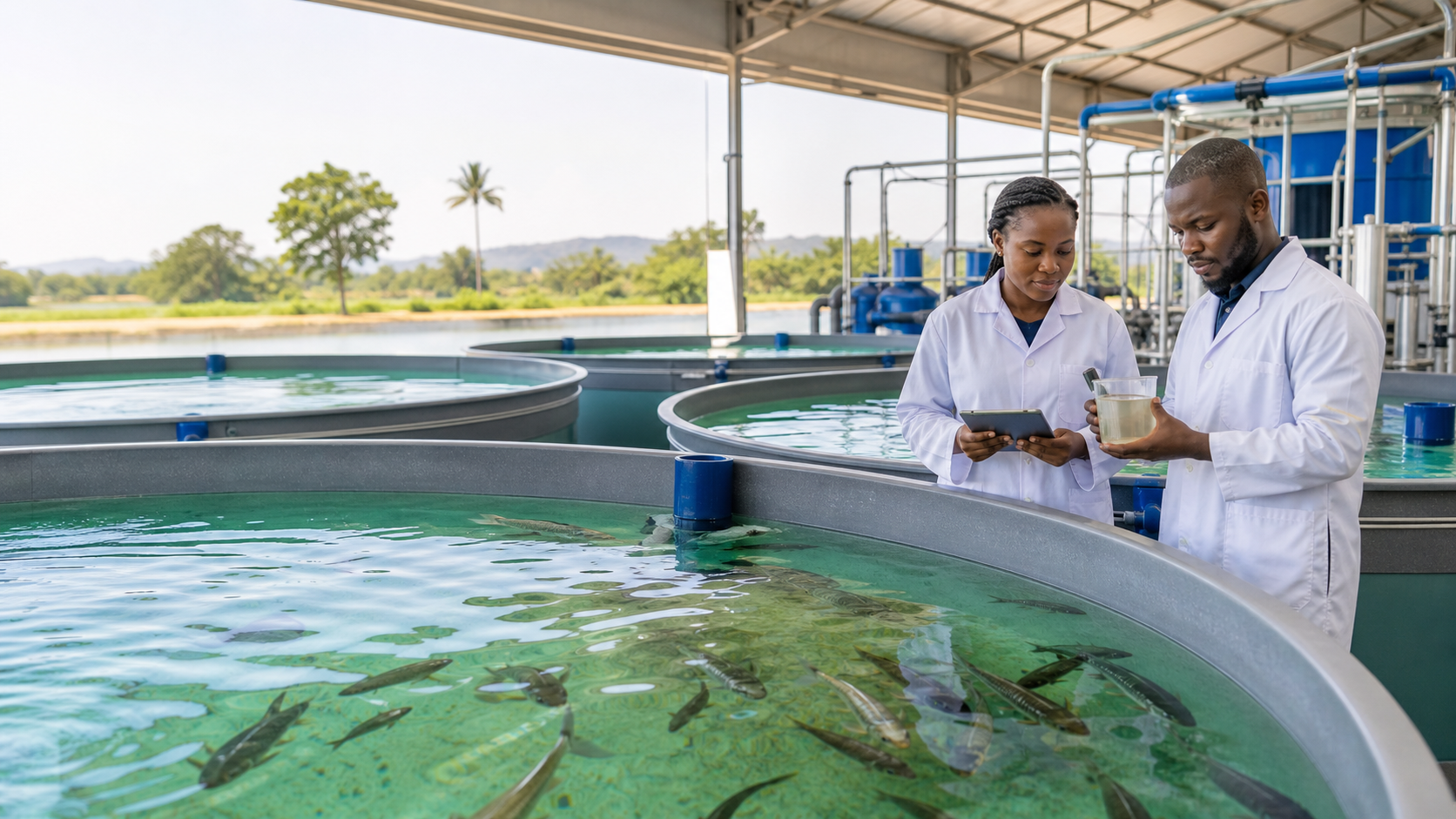
A recirculating aquaculture system treats and reuses water through mechanical and biological processes. RAS can offer greater environmental control and water efficiency, but it requires sound design, reliable power, monitoring, backup systems and trained operators. It should not be treated as an automatic substitute for management.
Site Selection and Water Quality
Before building, confirm that the location has dependable water, drainage, access, security, power options, room for safe expansion and reasonable proximity to customers and suppliers.
Core water-quality considerations
- Dissolved oxygen: fish need adequate oxygen for survival, feeding and growth.
- Temperature: affects appetite, metabolism and oxygen demand.
- pH: extreme acidity or alkalinity can stress fish and affect biological filtration.
- Ammonia and nitrite: waste compounds can become toxic when feed, density and filtration are poorly managed.
- Water clarity and odour: sudden changes can provide an early warning of a developing problem.
Test the actual water source before stocking. Clear-looking water is not proof that its chemistry is suitable for fish.
Fingerlings, Juveniles and Stocking
Stock quality strongly influences the production cycle. Buy from a reputable fish hatchery that grades fish properly, manages health and can explain the stock supplied. Healthy fish should be active, reasonably uniform and free from obvious injury or deformity.
Standard fingerlings are smaller and may cost less per fish, while post-fingerlings, juveniles and post-juveniles offer progressively larger grades. The best choice depends on experience, system, budget, transport and production target. Review Jentan’s current fish fingerlings and juveniles price guide.
Stocking principles
- Set density according to water volume, oxygen, filtration and management capacity—not ambition.
- Prepare the system and test water before the fish arrive.
- Transport during suitable conditions and minimize delay.
- Acclimatize fish gradually to reduce temperature and water-quality shock.
- Count, inspect and record every stocked batch.
Feeding and Growth Management
Feed is usually one of the largest operating costs. Use appropriate feed for the fish species and size, store it in a dry and secure place, and avoid guessing feeding quantities. Observe appetite and adjust feeding in response to biomass, temperature, health and water conditions.
- Use a pellet size the fish can consume comfortably.
- Feed consistently and watch the response at every session.
- Avoid overfeeding; uneaten feed wastes money and damages water quality.
- Sample and weigh fish periodically to estimate biomass and growth.
- Grade when necessary to reduce severe size differences and cannibalism.
- Record feed used so feed conversion and production cost can be evaluated.
Fish Health and Biosecurity
Biosecurity is the set of measures used to prevent disease from entering or spreading through a farm. Prevention is usually less expensive and more reliable than trying to solve a serious outbreak.
- Source stock from reputable hatcheries and quarantine where appropriate.
- Restrict unnecessary movement of visitors, equipment and animals.
- Clean and disinfect dedicated tools between production units.
- Remove mortalities promptly and record unusual behaviour.
- Do not medicate blindly. Seek competent professional advice when disease is suspected.
- Maintain backup aeration or power for systems that depend on pumps.
Records, Costs and Profitability
Profit cannot be managed without records. Keep separate records for stocking, feed, water tests, treatments, mortality, labour, power, maintenance, sales and customer credit.
Calculate before stocking
- Facility construction or lease
- Water, pumping, aeration and backup power
- Fingerlings or juveniles
- Feed from stocking to harvest
- Labour, security and transport
- Testing, maintenance and emergency allowance
- Expected survival, harvest weight and realistic selling price
A farm is profitable only when its confirmed sales income exceeds all direct and indirect costs. Do not base a business plan on perfect survival, maximum growth or the highest market price.
A Practical Starting Plan
- Study the market: identify who will buy, what size they need, how they buy and when demand is strongest.
- Get practical training: learn routine operations before investing heavily.
- Choose the system: match it to water, site, power, budget and management capacity.
- Prepare a complete budget: include working capital through harvest, not just construction.
- Build and test: run the water and aeration systems before receiving fish.
- Source quality stock: select the correct grade and plan safe transport.
- Start at a manageable scale: prove your procedures before expanding.
- Record and review: compare actual performance with the plan every week.
Common Beginner Mistakes
- Starting construction without testing the water or market
- Stocking more fish than the system can safely support
- Buying cheap but weak or poorly graded stock
- Underestimating feed and power costs
- Overfeeding or feeding without biomass estimates
- Ignoring water quality until fish stop eating
- Operating without backup aeration, drainage or emergency plans
- Keeping no production or financial records
- Waiting until harvest before looking for customers
Start with confidence
Begin Your Fish Farming Journey With the Right Foundation
Join the Jentan Fisheries priority list to receive production updates, stock availability information and practical support when choosing fingerlings or juveniles for your farm.
Join the Waiting ListJentan Fish Hatchery & Farms Limited1 Jentan Close, off Nnewi–Ozubulu Road, Ozubulu, Anambra State
Website: jentanfisheries.com
Email: info@jentanfisheries.com